Recognizing who contributed to a piece of work is too important to leave to informal negotiation among coauthors. This is where COPE, ICMJE and CRediT come in, three instruments that together turn authorship from a backstage arrangement into a standard editorial practice: documented, explicit and auditable. They are not extra bureaucracy, and they are not a courtesy to be settled after the fact. They are the difference between a list of names whose order no one can explain and a verifiable declaration of who did what, with responsibility assigned. When that standard is missing, what appears is not just disorganization; it is systematic misattribution, and it has been measured.
The size of the problem is documented. Wislar and colleagues (2011)1 surveyed corresponding authors of articles in six high-impact medical journals and classified each article against ICMJE criteria, measuring how much honorary authorship, names that did not meet the criteria, and ghost authorship, contributors left off the list, appeared in each article type.
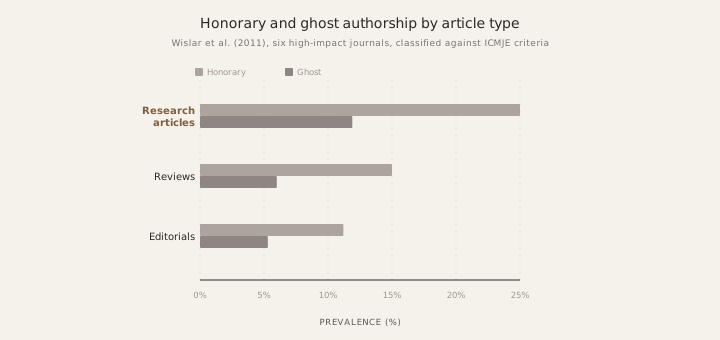
The reading shows a problem no field can consider settled. Among research articles, 25.0% had honorary authorship and 11.9% had ghost authorship; among reviews, 15.0% and 6.0%; among editorials, 11.2% and 5.3%. This is not a rare deviation: it is a widespread practice that distorts credit across a large fraction of the literature, and because it depends on self-reporting, the true prevalence may be higher still than these figures suggest. And it is not new. Flanagin and colleagues (1998)2 had already quantified the same phenomenon in 1996, establishing authorship as the basis of accountability, responsibility and credit. The meta-analysis by Meursinge Reynders and colleagues (2024)3 confirms the scale: honorary authorship was perceived by 26% of researchers and rose to 51% when contributions were declared and compared against ICMJE criteria. The problem did not shrink on its own.
The three instruments address distinct parts of the same question. ICMJE answers who qualifies as an author, with four criteria requiring substantial contribution, participation in the writing, final approval and accountability for the work. CRediT answers what each person did: the taxonomy of roles described by Brand and colleagues (2015)6 moves recognition from a binary byline to a structured, checkable declaration of contribution. And COPE answers how to proceed when there is conflict or misconduct, providing the workflow editors follow to investigate and resolve authorship disputes. Eligibility, contribution and process: each covers a gap the others do not.
Knowing these instruments exist, however, is not enough. Schroter and colleagues (2020)4 find a telling picture: most authors know the ICMJE criteria, and yet 74% had experienced honorary authorship at least once; where the institution actively encouraged guideline use, authorship was discussed earlier and judged fairer. The conclusion is that the norm only changes behavior when it becomes a required practice, not merely a known one. And the problem is not confined to medicine: Pruschak and Hopp (2019)5, surveying 2,222 social scientists, find ghost and honorary authorship frequent, driven by misconceptions about the criteria, altering academic rankings.
The value of CRediT lies in making visible what the byline hides. A list of eight names does not say who conceived the study, who collected the data, who wrote it and who merely provided a sample. The taxonomy separates these roles into declared categories, from conceptualization and data curation to writing and supervision, so that each author’s contribution stops being inferred from position in the byline and is instead stated by the person who did it. This resolves, at the source, the question a reviewer cannot answer by looking at the names alone: what, in fact, did each person do to earn the credit.
Misattribution is not a labeling detail. Honorary authorship dilutes responsibility, because it spreads credit across people who cannot answer for the work, and inflates the records that decide hiring and funding. Ghost authorship is worse: by hiding who actually wrote a paper, it can conceal conflicts of interest, as in clinical trials drafted by sponsors and signed by academics. In both cases, what is lost is the chain of accountability that gives the byline its meaning. A standard that records contribution restores it.
The operating rule brings the three into a standard procedure. Decide authorship by the ICMJE criteria, not by hierarchy or lab custom, and discuss eligibility at the start of the project, not at the end. Declare each person’s contribution with the CRediT roles, so that credit and responsibility are explicit and verifiable. Follow the COPE workflow when a dispute or suspicion of misconduct arises, rather than improvising a resolution. And on the institutional side, require and encourage these practices, because it is active encouragement, not the mere availability of the norm, that reduces misattribution. Recognition of contribution done this way stops being a negotiable courtesy and becomes what it should have been all along: a standard editorial practice, documented and accountable.