The misconception circulates from the first submission any researcher makes to an indexed journal, and it survives because it contains a grain of truth. Q1 journals published in English do expect well-written English, and professional language editing reduces friction. Reducing friction is not what decides a desk rejection. The decision happens during the short read an associate editor performs before sending a manuscript out for peer review, and that read answers three structural questions that have no direct bearing on grammar.
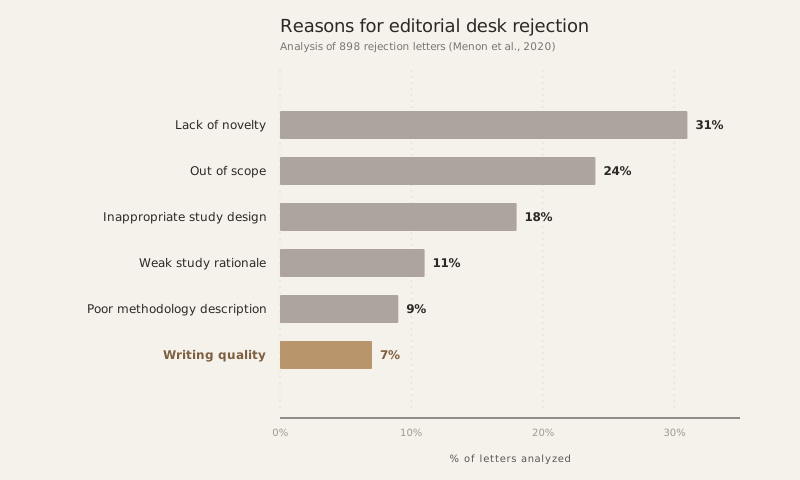
The available evidence from systematic analyses of editorial rejection letters supports this reading. The most detailed study available, conducted by Menon and colleagues across 898 rejection letters extracted from the manuscript management system of the Indian Journal of Psychological Medicine between 2018 and 2020, found that the most frequent reasons for desk rejection were not language problems but lack of novelty and scope mismatch 1. A parallel finding appears in an analysis of 369 manuscripts submitted to Academic Medicine between 2014 and 2015: the most frequent category of internal rejection was “ineffective research question and study design,” present in 92% of the analyzed cases 2.
The four-minute read by the associate editor
The flow is predictable at any high-impact journal. The associate editor receives the manuscript through the submission system, opens the PDF, and spends the first minute on the abstract. If the abstract does not deliver a clear contribution, the editor goes straight to the methodology, spends the second minute evaluating whether the method answers the stated research question, and the third on the results, looking for the central finding. The fourth minute is the decision.
Manuscripts that survive that cycle move to peer review. Those that do not survive receive a desk rejection with standardized language citing one of three official reasons: out of scope, insufficient contribution, or quality below journal standards. None of the three names English as the primary cause.
Desk rejection rates vary substantially across fields. In political science journals analyzed by Garand and colleagues, elite venues such as the American Political Science Review operate with desk rejection rates above 60%, reflecting a conscious decision to protect reviewers from overload 4. At management journals such as Project Management Journal, editors-in-chief have reported desk rejection rates of 60 to 70% of submissions in 2018, with stable volume year over year 3. The scale of the editorial funnel is larger than most authors assume.
Calibration between thesis and venue before writing
The first structural reason for desk rejection is miscalibration. The manuscript has merit, but it was submitted to a journal whose stated mission does not accommodate the contribution. The editor reads the abstract, identifies the misalignment, closes the PDF. The author receives an “out of scope” letter and attributes it to editor arbitrariness, when the failure actually occurred months earlier, in the venue selection that ignored the past twelve months of the journal’s published output.
Journals publish annual editorials about what they are looking for. They take twenty minutes to read and save months of rework. Authors who skip this step end up submitting applied psychometrics papers to venues that have pivoted toward computational psychometrics, or qualitative work to journals that have shifted to mixed methods, and then learn at desk rejection that the problem was never the content. The synthesis of nine information-management journal editors collected by Dwivedi and colleagues is explicit: fit failure is the cause that appears on every list of desk rejection reasons 3.
Reading the journal’s “Aims and Scope” alone is insufficient. Those texts change little year to year. The real signal lies in editorials and special-issue calls from the past 12 to 18 months, which reveal what the editorial board is prioritizing in the present moment.
Abstract as decision point
When thesis-venue calibration is right, the second place where manuscripts die is the abstract. In many social science and humanities fields, the traditional abstract is still narrative: it introduces context, indicates the method, suggests findings, and closes with implications. That format works when the editor has time. An editor at a Q1 journal handling hundreds of submissions per month does not have time.
Koyamada and colleagues analyzed 591 abstracts submitted to the Journal of Visualization, including both accepted and rejected, and found significant structural differences between the two groups. The authors were able to train a machine learning classifier capable of predicting the editorial outcome from the structure of the abstract alone, with performance sufficient to support the hypothesis that abstracts follow recognizable patterns that correlate with acceptance 5. The signal is not the presence of specific words; it is the rhetorical sequence.
A complementary analysis by Vincent-Lamarre and colleagues across manuscripts submitted to artificial intelligence conferences arrived at a counterintuitive finding. Accepted manuscripts scored lower on conventional readability indicators, used more technical jargon, and employed more abstract vocabulary than rejected ones 6. The direct interpretation is that abstracts that succeed in technical venues are not the “clearest” in the journalistic sense; they are the most precise in the register the reader community expects.
An abstract that survives in its first few dozen words delivers four elements in order: the specific research question, the method with its technical particularity, the central finding with its magnitude, and the theoretical or practical contribution that separates this paper from similar work already published. Whatever comes after is development; whatever comes before those four elements wastes the cognitive space of the most overworked reader in the editorial cycle.
When the problem is, in fact, linguistic
There is a scenario in which weak English does sink a manuscript at desk rejection, and it deserves naming to avoid confusion. When literal translation corrupts the argumentative structure to the point where the editor cannot reconstruct what the author is trying to say, the desk rejection comes back with an explicit “language quality” note or a recommendation to use a language editing service. This is not cosmetic; it is a communication failure that prevents reading.
That scenario is a minority of cases in the available data. In the Menon and colleagues analysis, “poor writing quality” appears as a rejection category but combined with other structural failures; it is rarely an isolated cause 1. This differs from the “imperfect but readable English” problem. Manuscripts with imperfect English but intact argumentative structure pass to peer review and receive language polishing recommendations alongside the other revisions. They do not die at desk rejection because of English.
The conflation of those two scenarios, “weak but readable English” and “English broken to the point of preventing reading,” is what sustains the myth that desk rejection is a language problem. The numbers from editorial flow analyses across major publishers tell a different story. Strategic venue calibration, abstract architecture, and coherence between sections account for most of the difference between a paper that survives the initial editorial cut and one that returns without ever reaching reviewers. Investing in language editing before addressing those three fronts is optimizing the wrong stage of the process.