A recurring pattern appears in psychology, education, and health-sciences manuscripts that cross linguistic borders. The original instrument was validated in English, translated into Brazilian Portuguese following the back-translation protocol, and the author reports a satisfactory Cronbach’s alpha in the Brazilian sample. Mean comparisons across groups follow — Brazil versus United States, men versus women, before versus after an intervention — and the differences found are discussed.
Peer review at Q1 journals in the field rarely lets such a manuscript through without a specific question: was the instrument tested for measurement invariance across the groups being compared? If the answer is no, the comparison may be measuring different constructs while presenting the result as if it were the same one.
What measurement invariance actually tests
Measurement invariance assesses whether an instrument measures the same construct, with the same structure, on the same metric across groups or time points. Putnick and Bornstein (2016), in a review published in Developmental Review covering 126 studies and 269 invariance tests, formalized the current convention of progressive hierarchical testing across four levels.
The configural level verifies whether the basic factor structure — how many factors exist, which items load on which factors — is the same in both groups. The metric level adds the constraint of equal factor loadings, a necessary condition to compare covariances and correlations across groups. The scalar level adds the constraint of equal intercepts, a necessary condition to compare latent means across groups. The strict level adds the constraint of equal residuals, a requirement in few cross-cultural contexts.
The operational consequence is severe. Without established scalar invariance, the claim “group A scores higher on anxiety than group B” may be reflecting not a real construct difference but systematic response bias. Items may be interpreted differently in each culture, and the observed mean difference absorbs that noise.
The typical failure pattern
In real projects, the most common pattern is not total failure — it is localized failure at the scalar level. The configural model passes, the metric model passes with room to spare, and the scalar model fails because two or three items have intercepts that differ substantially across groups. This is the case the methodological reviewer identifies immediately, and where partial invariance enters as a documented solution.
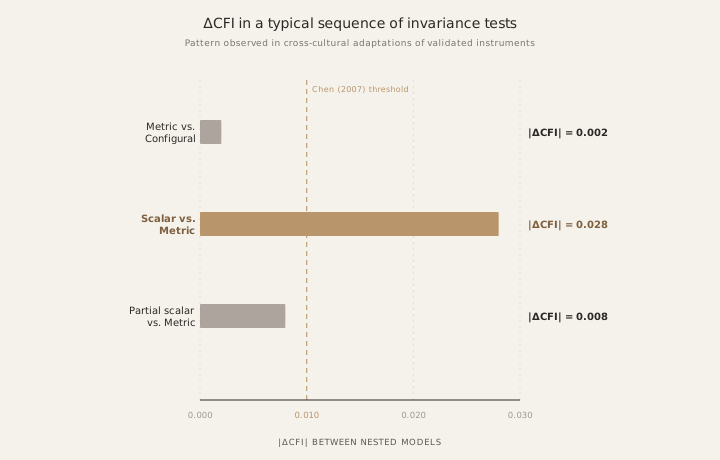
Partial scalar invariance, formalized by Byrne, Shavelson, and Muthén (1989) and updated by Putnick and Bornstein (2016), allows mean comparisons to continue provided that at least two items per factor retain invariant intercepts. The solution is not cosmetic — it requires theoretical justification for each release, requires reporting which items diverged, and requires discussing what that divergence means substantively.
Why most manuscripts skip the test
Three reasons recur. The first is methodological unfamiliarity: the author learned to test internal consistency via Cronbach’s alpha and assumes that exhausts the question of psychometric equivalence. The second is confidence in the translation protocol: back-translation was performed, an expert committee approved, a pilot panel raised no concerns, and equivalence is assumed. The third is absence of software or expertise: invariance tests require structural equation modeling with increasing constraints, appropriate software (lavaan, semTools, Mplus, AMOS), and technical reading of fit indices.
None of these reasons holds when the methodological reviewer opens the validation section. High internal consistency in each group is compatible with non-invariance. A careful translation protocol reduces failure probability but does not replace the empirical test. And the absence of an invariance test is, in itself, a methodological omission sufficient for critical review or desk reject at journals with rigorous quantitative-method standards.
What to deliver in the validation section
The validation section of a manuscript comparing groups via questionnaire should contain, in the order reviewers look for them: descriptive statistics by group, evidence of internal consistency by group, configural invariance test with reported fit indices, metric invariance test with ΔCFI, ΔRMSEA, and ΔSRMR compared to Chen’s (2007) thresholds — ΔCFI < 0.010, ΔRMSEA < 0.015, ΔSRMR < 0.015, scalar invariance test with the same thresholds, and, if scalar invariance fails, a partial invariance test with justification for each released item.
The R code that executes this sequence via lavaan fits in under fifty lines. Mplus operates with equivalent syntax. The computational cost is low. The cost of skipping it is a full revision round to reanalyze data that were already in the bank.