Almost all of the object detection literature is evaluated over two worlds: ImageNet and COCO. They are large, well-labeled and diverse, which is why they became the standard ruler. The problem appears when the detector leaves that world. Medical imaging, remote sensing, wildlife monitoring, industrial inspection and underwater scenes have their own distributions of appearance, scale, lighting and context, and a model with high performance on the standard benchmark can collapse, quietly and without warning, when the deployment domain leaves the training distribution it was built on. The field is larger than ImageNet, and treating the benchmark number as proof of readiness for the real domain is the error a reviewer looks for first.
The reason is that domain shift is the rule, not the exception. Chen and colleagues (2018)2 state the problem plainly: detection assumes training and test come from the same distribution, and when that premise fails the performance drop is significant. The corollary is that the standard prior is not always the right prior. Wang and colleagues (2022)3 show that the natural images of ImageNet carry a large domain gap relative to aerial images, so standard pretraining limits remote-sensing detection, while pretraining on the domain’s own distribution helps. And Schäfer and colleagues (2024)4 take the argument to biomedical imaging: a foundation model trained on in-domain data outperformed ImageNet pretraining and needed far less data for out-of-domain tasks. For a specialized domain, the domain prior beats the standard one.
The magnitude of this drop can be measured. Zhuang and colleagues (2026)1 evaluated a YOLOv7 detector in a domain well outside ImageNet, livestock monitoring, comparing performance inside and outside the training domain.
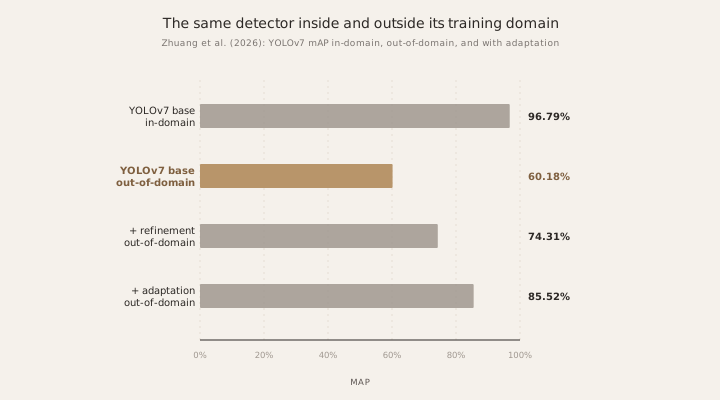
The reading is the whole argument. The same detector that scores 96.79% mAP on its training domain falls to 60.18% when the animal’s breed changes, a loss of about 36 points with nothing in the model altered. Architectural refinement recovers it to 74.31%, and domain adaptation with sample generation reaches 85.52%, still below the original level. The honest caveat is that this particular drop mixes domain shift with data scarcity on the target, since the out-of-domain set was small; but the direction is the one that appears in every out-of-distribution detection study, and the point survives: source-domain performance does not predict target-domain performance.
There is also the temptation to trust the standard model’s robustness, and that too does not transfer for free. Yamada and Otani (2022)5 show that robustness built on ImageNet classification does not reliably carry over to object detection or to classification in other domains. A model validated on ImageNet is validated for ImageNet, not for the clinic, the satellite or the pen. Treating one as the other is exactly where detection engineering fails when it leaves the lab.
The cost of ignoring this distance shows up in the field, not in the paper. A detector that passes the benchmark and is taken straight into real operation tends to fail in ways the public set never anticipated: it misses objects under different lighting, confuses rare classes that barely appeared in training, and fires false positives on textures the standard domain never contained. In consequential applications, such as diagnostic imaging or counting endangered wildlife, that silent error is worse than no model at all, because it comes wrapped in a benchmark number that grants false confidence. The difference between a system that works and one that merely scores well is having measured the detector where it will actually operate, with the target’s objects, conditions and class frequencies, before trusting it. The benchmark opens the investigation; it does not close it.
Even the largest general models do not escape this. Open-vocabulary and foundation detectors bring impressive zero-shot range, yet their performance still degrades under domain shift, which is why recent work converges on the same answer: collect or simulate domain data, adapt, and validate in place. Scale widens the set of domains a model handles acceptably; it does not abolish the boundary where the training distribution ends.
The operating rule follows directly. Never assume that standard-benchmark performance transfers to the deployment domain; measure the detector on the real target data, not only on the public set. Budget the domain shift explicitly in the project, planning for labeled domain data, domain-specific pretraining where it exists, and adaptation techniques when target data is scarce. Report cross-domain performance, inside and outside the domain, rather than displaying only the favorable benchmark number. And state the model’s operating boundary, the range of conditions under which it was actually evaluated. Object detection beyond ImageNet is not a trivial extension of the benchmark; it is a problem of its own, with its own distribution and its own failure modes, that has to be measured where the model will actually operate, and not only where it was trained, before any claim of readiness is made.