In predictive modeling for the social sciences, AUC is the metric everyone reports and, at the same time, the one that says least about whether the model is any good. The area under the ROC curve measures one thing: the ability to rank, to give a positive case a higher score than a negative one. That is a useful property, but a partial one. It says nothing about whether the predicted probabilities are correct, about whether using the model to decide does more good than harm, and about the hard limit of how predictable a social outcome is. Presenting a high AUC as proof that a model is good mistakes one slice of the evaluation for the whole of it, and quietly so, and an attentive reviewer sees the gap on first reading.
The first blind spot is the predictability ceiling. Salganik and colleagues (2020)2 organized a mass collaboration, the Fragile Families Challenge, in which 160 teams built models for six life outcomes from a rich cohort dataset. Even with machine learning optimized for prediction, the best predictions were only slightly better than a simple benchmark, with accuracy of about 0.2 for two outcomes and about 0.05 for the other four. The lesson is uncomfortable: many social outcomes are weakly predictable, and a metric that looks good can be masking a model that barely beats the informed guess.
The second problem is that high discrimination at derivation does not survive external validation. Gulati and colleagues (2022)1 performed 158 independent external validations of 104 prediction models and measured the discrimination of each one at derivation and then in new populations.
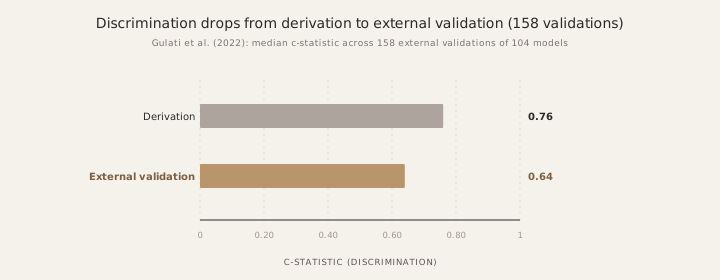
The reading undoes the idea that the derivation c-statistic is a fixed label of the model. The median falls from 0.76 to 0.64 when the models are tested in new populations, and about half of that drop comes from the narrower case-mix in the validation samples. It is discrimination measured in the best case, at derivation, that does not hold up outside it. Reporting only the derivation number overstates how well the model generalizes. And what holds from derivation to external validation also holds for subgroups and for the outcome’s prevalence: an aggregate c-statistic hides that the model discriminates well in one group and poorly in another.
Then there is what AUC, by construction, cannot see. Van Calster and colleagues (2019)3 call calibration the Achilles heel of predictive analytics: a model can rank cases very well, with a high AUC, and still issue systematically wrong probabilities, saying thirty percent when the real risk is ten. Discrimination does not see that error; only calibration measures it. And there is the decision dimension: Vickers and Elkin (2006)5 introduce net benefit and decision curve analysis, which ask whether using the model to act, at a given threshold, produces more benefit than harm. A model with a good AUC can be useless, or harmful, in the real decision, and no ranking statistic warns of it.
These blind spots are not academic when the model decides about people. A risk instrument used to inform parole, benefit allocation, or school triage carries real consequences with every probability error, and that is exactly where AUC misleads most. A model that ranks well but is poorly calibrated assigns an individual a forty percent risk that is really fifteen, and the decision made on that number is unjust even if the ranking is correct. A model whose AUC drops in a subgroup discriminates worse precisely for those the system already tends to fail, and the aggregate number hides that failure. And a model whose net benefit is negative at the threshold of use causes more harm than no model at all, however high its AUC. In socially consequential outcomes, reporting only discrimination is not an omitted technicality; it is the part of the evaluation that would protect the people affected. Discrimination tells you the model can sort; the rest tells you whether the sorting helps.
The consequence is not to abandon AUC but to stop treating it as the verdict. Steyerberg and colleagues (2010)4 offer the framework that organizes this: discrimination, calibration and clinical usefulness are distinct properties, each with its own measure, and a serious model is reported with all three. The operating rule follows. Report discrimination, calibration and decision value together, never AUC in isolation. Check the stability of discrimination across subgroups and from derivation to external validation, rather than a single number taken from the most favorable condition. Compare the model with a simple baseline, to show that it actually adds, and place the result against the outcome’s predictability ceiling. And when the outcome is socially consequential, state plainly, and early in the paper, the limit of what the model can and cannot predict. A high AUC can be the start of a good evaluation; taken as the end, it is the most elegant way of not saying whether the model is any good.