Multiple mediation asks why an effect happens, not only whether it exists. When more than one mechanism sits between cause and outcome, the quantity of interest is the indirect effect, the product of the paths linking the independent variable to the mediator and the mediator to the outcome. That product is exactly what ordinary linear regression does not deliver well: it estimates each path on its own, but the inference on the product, and on several competing products inside one model, calls for a different instrument. This is where regression stops and structural equation modeling begins to answer.
The first limit shows up the moment there is more than one mediator. Running a separate regression for each mediator treats every mechanism as if the others did not exist, ignores the correlation among them, and forecloses the one question that makes a multiple model worth fitting: which mechanism carries more of the effect. Preacher and Hayes (2008)2 formalize the parallel multiple-mediator model and the contrasts among indirect effects within a single fit, with resampling-based inference. One model, all mediators, the indirect effects estimated jointly and comparable to each other: that is what a cascade of regressions cannot offer.
Structural equation modeling adds three things that least-squares regression cannot supply at once. It estimates every path in the model simultaneously, rather than in isolated regressions that never speak to each other. It absorbs latent variables, separating the construct of interest from the measurement error that, left inside the observed variables, biases the coefficients and with them the indirect effects. And it returns fit indices that let an analyst judge the whole model, not only each local relation. The difference is not cosmetic: Leth-Steensen and Gallitto (2016)7, simulating full latent-variable mediation models, find that the joint-significance test had more power and more reasonable Type I error rates than the bias-corrected bootstrap. When the construct is measured with error, SEM, not regression on observed scores, is the correct model.
With the model settled, the inference on the indirect effect remains, and here the choice of method leaves measurable marks. The sampling distribution of a product of paths is not normal, so the confidence interval needs resampling. Hayes and Scharkow (2013)3 show that the tests agree in most cases but diverge precisely when an indirect effect exists to detect, which is when the decision matters. The question is no longer whether to bootstrap but which bootstrap, and Tibbe and Montoya (2022)1 measure the price of each answer.
In a Monte Carlo comparison of five bootstrap intervals for the indirect effect, with the a-path equal to zero, the b-path at 0.39, and n equal to 100, the percentile bootstrap held a Type I error rate of 0.062, inside Bradley’s liberal robustness ceiling of 0.075. The two bias-corrected methods, the classic interval and its significance-tested variant, reached 0.088, above that ceiling. The intermediate corrections fell between the two. The figure lays out the full order.
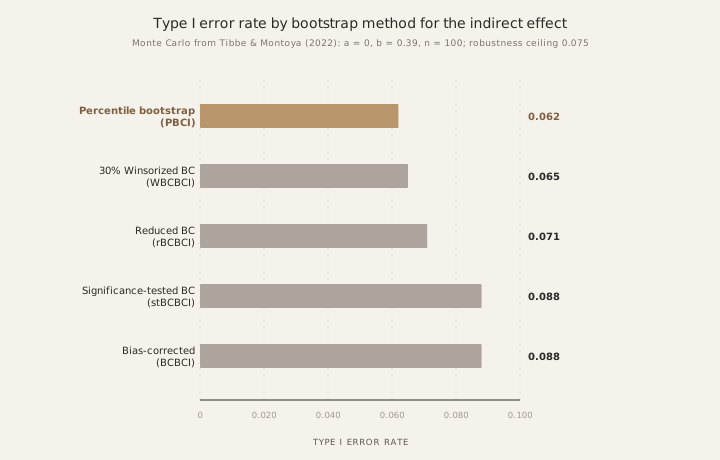
The operational reading of that figure is that there is no free power. The detection gain of bias correction is paid in false positives, and Tibbe and Montoya (2022)1 show that once the Type I error rates are equalized across methods, much of that extra power disappears. For most applications, where containing the false positive matters more than wringing out the last point of power, the percentile bootstrap remains the default. When the raw data are not available and only the estimates and their covariance matrix remain, the Monte Carlo interval described by Preacher and Selig (2012)6 reproduces the performance of resampling without resampling, and covers the case where the bootstrap is impractical.
With the right model and the right interval, multiple-mediator analysis opens questions that regression never even poses. Comparing two indirect effects within one model requires distinguishing a difference in value from a difference in magnitude, and Coutts and Hayes (2022)4 supply the methods that answer that comparison consistently, implemented in SEM. When the mediators form a chain rather than parallel paths, the demand on the method tightens: Tofighi and Kelcey (2019)5, in a two-mediator sequential model, find inflated Type I error and under-coverage in the popular bias-corrected bootstrap, and show that the best method for testing the hypothesis is not the best method for building the interval. A chain of mediators is natural SEM territory, not a sequence of regressions strung together by hand.
The operational rule fits in three decisions. The whole system, with parallel or serial mediators and latent constructs, is estimated at once in SEM, never as a pile of independent regressions. The indirect effect is tested with a resampling interval, the percentile bootstrap as the default when containing Type I error matters, and the Monte Carlo interval when only summary estimates are at hand. Bias correction stays reserved for the cases where power is the declared priority and the false-positive inflation has been measured and accepted, not adopted by habit. Multiple mediation done this way answers the question that linear regression only pretends to answer.