An exploratory visualization and a publishable visualization are two different objects, not two finish levels of the same chart. They have different audiences, different shelf lives, and different rules. Treating the figure in a paper as a direct export of the chart the analyst used to think is one of the most common errors in submission, and a reviewer catches it at a glance: the figure was built for someone who already knows the data, not for someone meeting it for the first time.
The exploratory visualization is a working tool. It serves one person, the analyst, who knows the dataset, generates dozens of them in a session, and discards each one as soon as it answers the question that prompted it. Library defaults are fine, labels can be missing, aesthetics are beside the point. What matters is the speed with which it lets a pattern surface. The choice of chart type here follows the task of the moment, and Saket and colleagues (2019)4 show that this match is measurable: bars to compare values, lines for trend, scatter for correlation. The exploratory chart succeeds when it answers its maker’s question quickly, and nothing more is asked of it.
The publishable visualization is a different object. It is read once, with no author nearby to explain, by a reader whose perceptual system decides in fractions of a second what it can extract. Healey and Enns (2012)6 describe how preattentive attributes govern that extraction before any conscious reading, which is why the figure has to be engineered for perception, not for taste. The empirical basis for that engineering is old and stable: Cleveland and McGill (1984)2 ranked the elementary perceptual tasks by accuracy, with position on a common scale at the top, then length, then angle and slope, and area last. Heer and Bostock (2010)3 replicated that ordering at scale and confirmed that it holds. The consequence is direct: the encoding of a publishable figure is a choice defensible by evidence, not a preference.
The difference becomes concrete in a mundane example. The same set of proportions the analyst inspects in three seconds with a pie chart, tilting the screen and comparing slices at a glance, reaches the paper’s reader as a claim he cannot verify: similar slices force him to estimate angles, and angle is precisely the task the eye performs worst. Replacing that pie with an ordered bar chart does not change the data, it changes the perceptual task asked of the reader, from estimating angles to comparing lengths aligned to a common base. The analyst could afford the pie because he already knew the answer; the reader does not, and the figure is all he has. That is why the same information demands different visual objects at the two ends: one that speeds discovery for someone who knows the data, another that protects the reading of someone meeting it for the first time.
That the format changes interpretation is not intuition, it has been measured. Brundage and colleagues (2018)1 randomized clinicians and researchers across different formats for the same trial results and measured how accurately and clearly each format was interpreted.
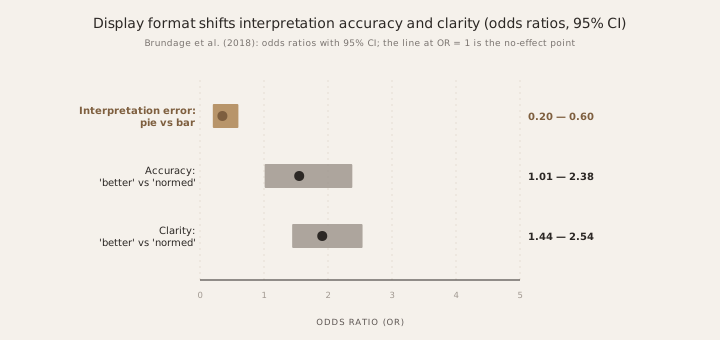
The reading shows three effects of format. Presenting the same result with ‘better’ graphs, where higher always means better, was interpreted more accurately than the ‘normed’ version (OR 1.55; 95% CI 1.01-2.38) and rated clearer (OR 1.91; 95% CI 1.44-2.54). And for proportions, pie produced fewer interpretation errors than bar (OR 0.35; 95% CI 0.2-0.6), a result that runs against the perceptual hierarchy and for that very reason teaches the lesson: the effect of format is empirical and task-dependent, not deduced from a general rule. Choosing how to publish a result is therefore an integrity decision, not an aesthetic one: the format changes what the reader understands, and the author answers for it.
The same reasoning condemns the ornaments tools export by default. Dense gridlines, drop shadows, three-dimensional effects and rainbow palettes add no information; they compete with it for the reader’s preattentive attention and, in the 3D case, actively distort the magnitudes the figure is meant to convey. In the exploratory chart these elements are harmless, because the analyst ignores them without effort. In the publishable figure, every mark that carries no data is noise the reader must filter before reaching the argument, and filtering costs the attention that should go to the content. Stripping the superfluous is not aesthetic minimalism, it returns to the data the perceptual channel the decoration had taken.
There is also what the figure has to say without help. In the analysis notebook, the chart lives surrounded by context: the code that produced it, the variables in the analyst’s memory, the question that prompted it. The publishable figure loses all of that and has to rebuild it inside its own frame: a title that states the finding, axes with units, a legend that does not force the eye to hunt for matches, and a single question per figure rather than six panels the reader does not know where to start with. Borkin and colleagues (2013)5 studied empirically what makes a visualization memorable, and the result matters because a paper’s reader sees the figure once and has to carry it forward.
These demands translate into concrete choices a reviewer checks. The value axis starts at zero when the comparison is one of magnitude, because truncating it distorts the ratio between the bars the reader is trying to estimate. The aspect ratio is chosen so that the relevant slopes sit near forty-five degrees, the condition under which change is read with the least error. The label sits directly beside its series instead of forcing the eye to travel back and forth to a distant legend, and the palette survives color vision deficiency because color is never the only channel separating two categories. Cleveland and McGill (1984)2 already treated these choices as part of perceptual accuracy, and Saket and colleagues (2019)4 remind us that each of them only makes sense relative to the task the figure has to serve.
The operating rule separates the two objects without ambiguity. The exploratory chart stays in the analysis notebook and is never exported straight into the paper. The publishable figure is rebuilt from scratch, with the encoding chosen by task and perceptual accuracy, an honest axis starting where it should, complete labels, contrast and font size legible in print and on screen, and color vision deficiency considered in the palette. Each figure answers one question and stands on its own, without the paragraph’s caption propping it up. Whoever treats the figure as the last step of the analysis hands the reader a draft; whoever treats it as an object of its own, engineered for the reading eye, hands over the argument.