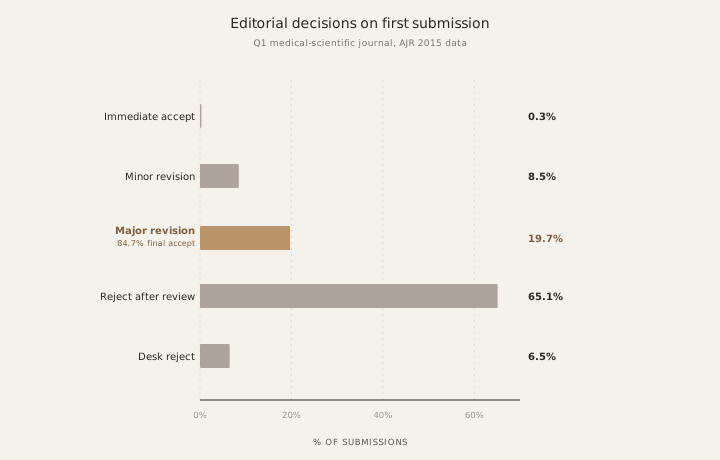
Most manuscripts submitted to Q1 international journals are not accepted in the first round. A 2015 American Journal of Roentgenology paper documenting detailed editorial decisions at a representative journal in the segment records that only 0.3% of new submissions receive immediate acceptance. Another 8.5% receive minor revision, 19.7% receive major revision, and the majority — 65.1% — is rejected after review. Reject without review accounts for an additional 6.5%.
The distance between major revision and final acceptance is where the response letter decides the manuscript’s fate. In the same dataset, 84.7% of manuscripts receiving major revision on first submission ended up accepted after one or more revision rounds. Major revision is not a final verdict — it is the window in which the competence of the response determines the outcome.
What reviewers evaluate in a response
The response letter is evaluated against three implicit criteria. The first is whether each comment was handled individually. Letters that respond by generic blocks — “we incorporated the reviewer’s suggestions” — fail for lack of traceability. The reviewer cannot verify whether the specific point raised was addressed. The second criterion is whether changes to the manuscript are located with precision. Reference to page number, line number, or color highlight makes verification immediate. Without it, the reviewer rereads searching for what changed. The third criterion is whether disagreements are justified with evidence, not rhetoric.
Hidouri and colleagues (2024), in an opinion piece published in the manuscript review segment, systematized the response letter format that increases acceptance probability. The structure is simple: concise acknowledgment, one-sentence summary of main changes, and then the point-by-point block with each comment quoted in italics, response in regular text, and precise reference to the change in the revised manuscript.
When to reanalyze and when to push back
The hardest decision in a response letter is discriminating when a reviewer’s comment requires data reanalysis, when it requires rewriting an argument, and when it requires substantiated rebuttal.
Reanalysis is appropriate when the reviewer identifies a real methodological problem or proposes a defensible alternative method: additional sensitivity analysis, a statistical model more appropriate to the data structure, control for a previously absent covariate. The correct response is to perform the reanalysis, report the result, and indicate where the manuscript was updated. Resisting legitimate reanalysis on time grounds is a strategy that gets discovered in the next round.
Rewriting is appropriate when the reviewer demonstrates that part of the manuscript is unclear — a poorly explained concept, a loose logical transition, an ambiguous figure. The correct response is to rewrite, show the new version, and thank the observation. Defending nonexistent clarity by arguing the reviewer is the only one who failed to understand is a losing strategy.
Substantiated rebuttal is appropriate when the reviewer proposes a change that conflicts with established convention in the literature, or when the comment is based on identifiable misunderstanding. The correct response is to disagree directly, cite the canonical reference supporting the original position, and explain why the reviewer’s suggestion, however well-intentioned, is not appropriate for the study’s design or context. Pushback works when there is canonical literature to cite; without it, pushback becomes opinion and loses to the reviewer’s opinion.
The rule that decides most cases
The operational rule covering 90% of response-letter decisions is simple: if the reviewer is probably right, make the change and thank. If the reviewer is probably wrong but there is literature supporting the original position, push back carefully and cite. If the reviewer is probably wrong and the original position is weak, it is time to revise the original position rather than defend it.
Manuscripts that circulate through three revision rounds generally fall into one of two categories: either the author has difficulty distinguishing methodological critique from stylistic disagreement, or the author responds on principle rather than merit. A competent response letter reduces three rounds to one.