After the first rejection, the most common strategic error is to resubmit by reflex to a lower-tier journal, as if the rejection were a verdict on the quality of the work and the next venue a consolation prize. The decision that separates published work from abandoned work is not persistence but fit. And choosing the second journal out of despair, rather than out of fit, tends to cost more than the initial rejection itself.
The reference data come from Calcagno and colleagues (2012)1, who mapped the flow of submissions across 923 journals. About three quarters of published articles were submitted first to the journal that published them, but high-impact journals published proportionally more articles resubmitted from elsewhere. The finding that matters for strategy follows: resubmissions receive more citations than first-intent submissions, except when the resubmission crosses into a different journal community, where they receive fewer. A second venue chosen by fit does not penalize, and often lifts the trajectory of the work. A second venue chosen as flight into another field pays the price in citations.
The decision of where to submit can be treated as a formal problem, not as intuition. Salinas and Munch (2015)2 model the choice as a decision process that balances acceptance probability, time to verdict, and impact, with fit and audience as explicit parameters. Paine and Fox (2018)3 show that journals reject low-impact work more often and rarely decline what will go on to be heavily cited, which argues for matching the significance of the work to the venue in order to reduce delay. And from the editor’s chair, Nakayama (2026)4 describes the typical rejection as a mismatch of scope and audience, not as flawed data: the path forward is to reframe the manuscript for the reader of the next journal, not merely to polish what was already there. Together these studies draw a consistent picture: rejection informs, and the information has a recipient, the next journal, not the author’s ego.
The figure below quantifies how often editorial screening actually errs in rejecting. Paine and Fox (2018)3, in ecology, measured the fate of declined manuscripts.
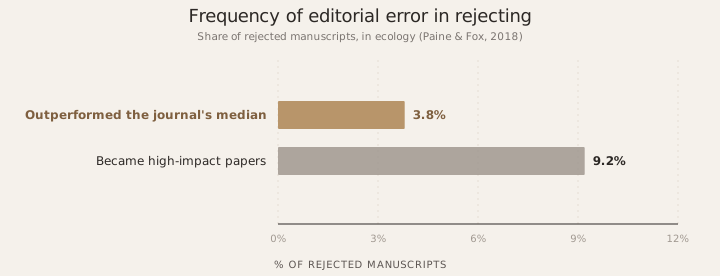
The operational reading is that rejection is almost never a verdict on the future impact of the work: only a small fraction of declined manuscripts would outperform the journal that rejected them. What actually protects a paper’s citation trajectory, as Calcagno and colleagues (2012) show, is not stepping down in prestige, it is resubmitting within the right community. The jump across communities, made in haste, is where citations are lost, and no gain in time offsets that loss.
The rule a strategic resubmission follows is fit before tier. The first step is to diagnose why the work was declined, and the rejection letter with its reviews usually says: mismatch of scope and audience, methodological flaw, or insufficient novelty. Each cause calls for a different action. When the rejection is about scope or audience, the fix is a better-matched journal, not a lower one. When it is methodological, stepping down a tier without redoing the analysis only postpones the same rejection. When it is about novelty, the object itself may need to change before the venue does. Reading the reviews with that question in front, which of the three causes they describe, yields more than reading them to argue back: classifying the cause is what determines whether the next step is changing the journal, redoing the analysis, or rethinking the object.
A concrete heuristic exists for this evaluation. Wong and colleagues (2017)5 treat submission as a multi-objective problem and propose ranking candidates by the conditional impact factor, the product of the impact factor and the acceptance rate. The measure captures what raw impact ignores: a journal of very high impact with a five percent acceptance rate has a lower expected value, for most work, than a mid-impact journal that actually publishes the kind of study in question. That turns fit into something quantifiable, rather than leaving it in the territory of guesswork.
The second step is to evaluate the candidates on the parameters that actually predict the outcome. Does the journal publish this kind of question, for this audience? What is the acceptance probability and the time to decision? Impact factor alone answers none of these questions. The third step is to avoid the jump across communities unless the work genuinely belongs in the new field, because that is where the evidence shows citations are lost. The reflex move, dropping a tier in the same field without reframing, wastes the reviews already received and returns the author to the same position a few months later.
A resubmission chosen by fit, rather than by discouragement, preserves the citation trajectory of the work and shortens the time to publication. The stakes are highest for sound work that was simply sent to the wrong room. Diagnosing the rejection correctly is what turns a setback into a redirection, and that is a decision made before the next submission form is opened.