The abstract is the artifact on which the paper is decided. Editors and reviewers triage on it before they open the body. The reader decides whether to read the rest from it. The 250-word limit that so many authors treat as a bureaucratic obstacle is in fact the cheapest test the manuscript faces: it is the compression that reveals whether the work has a contribution that can be declared in a few sentences. When it does not, the problem is not the word limit but the contribution.
The gatekeeping function of the abstract is measurable. Jiménez and colleagues (2020)1, analyzing roughly 750,000 titles and abstracts, show that the decision to read an article is made on the title and abstract, and that features of the abstract itself predict the future citability of the work. The abstract is not a summary of the paper but a decision object, and its form, not only its content, affects the outcome. For most potential readers, especially behind a paywall, the abstract is the only decision surface available: what is not in it, for that reader, does not exist. Hence the practical question: what form maximizes the chance that the work clears triage?
The answer has experimental support. Budgen and colleagues (2008)2, in a controlled experiment, show that structured abstracts significantly raise completeness and clarity relative to unstructured ones. Sharma and colleagues (2006)3 find the same effect when tracking journals that adopted the structured format: the quality of the information in the abstract rises. And Helbach and colleagues (2022)4, examining adherence to reporting guidelines in abstracts, show that adherence grows both with structure and with word count, and recommend a window of 250 to 300 words. The number is not arbitrary: it is the space where the essential moves fit without any one of them being sacrificed.
The figure below shows the declared preference of the participants in Budgen and colleagues’ (2008) experiment: among 57 respondents, 70% preferred the structured format.
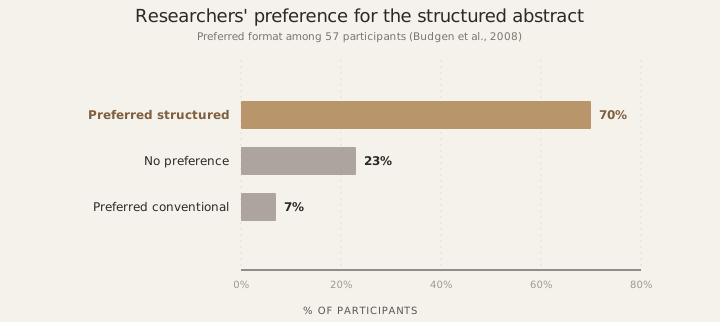
The operational reading is that structure is not decoration. It ensures that the four moves of the abstract are present and findable, and that is what triage rewards.
The rule that editors and reviewers apply can be stated in one sentence: the abstract must contain, in compressed form, the question, what was done, what was found together with the central quantity, and what it means. The 250 words force a prioritization. Every sentence that does not carry one of those four loads is cut, and what remains is the work reduced to its claim. The structured format, whether with explicit labels or with an implicit IMRaD sequence, beats the unstructured one because it ensures that the four moves appear and are found within seconds of reading.
Structure here is not a synonym for subheadings. Some journals require the abstract with explicit labels, such as Objective, Methods, Results, and Conclusion; others forbid labels and ask for a running paragraph. The principle survives both formats, because what triage rewards are the moves, not the labels. A well-built running abstract serves the same function as a labeled one: it carries the screener from the question to the meaning without making them search. The error is not choosing the wrong format, but leaving one of the four moves out, whatever the format.
The most common failures follow from that same criterion. When the abstract omits the magnitude of the finding, reporting that an effect occurred without saying how large, it delivers the less useful half of the information. When it buries the contribution in the middle of the paragraph, it forces the screener to search for it, and triage does not search. When it spends sentences restating what is already known, it sacrifices space that belonged to the result. The most frequent of the three is the third: the abstract that spends half its space restating the field and reaches its own finding with no room left to qualify it. Inverting that ratio, one sentence of context for three of contribution, is usually the highest-return edit an abstract receives. The 250-word limit is what exposes each of these failures: if the contribution does not fit in that space, it is not yet clear even to the person who wrote it.
An abstract built as architecture, rather than as summary, sets the visibility of the work before any merit of the body is weighed. The stakes are highest for strong work whose abstract reads as a table of contents instead of a claim. The 250 words are where the paper earns its own reading, and no well-written chapter recovers what a poorly architected abstract has already lost at triage.