Translating a manuscript word for word from Portuguese into English is one of the shortest routes to rejection at a Q1 journal, and almost never for the reason the author assumes. A reviewer rarely declines the text over a single vocabulary choice or an isolated grammatical slip. The reviewer declines because the prose, fully understandable as it may be, reads like a poorly assembled line of reasoning. The problem does not live in the words. It lives in the rhetorical structure that literal translation carries over intact from the source language. That is also why editing the text word by word does not reverse the rejection: it repairs the surface and leaves the fault where it sits.
The evidence that academic rhetoric varies across languages is specific to the Portuguese-English pair, not borrowed from other languages. Hirano (2009)1 compared research article introductions in Brazilian Portuguese and in English within a single subfield and found distinct organizational patterns: the English introductions follow Swales’s CARS model closely, while the Portuguese ones follow a different entry logic. Junqueira (2013)2 documented, across Brazilian academic genres, a conflict avoidance that extends to the research article: the text recommends without qualifying and evaluates without criticizing head-on. To an Anglophone reader, trained to expect an explicit gap statement and a critical stance toward the literature, that courtesy reads as the absence of an argument.
The phenomenon has a name in the literature. Moreno and colleagues (2012)3, surveying more than a thousand researchers, propose the rhetorical transfer hypothesis to explain why the discussion section is the hardest to write in English, a difficulty that does not vanish as proficiency rises. If the cause were command of the language alone, the difficulty would fall with fluency; it does not. A floor underlies all of this, and none of these studies disputes it: prose that breaks the expected fluency is penalized in judgment even when it remains understandable. Peters (2023)4 shows that processing disfluency triggers a negative epistemic appraisal, and editorial guidelines often frame the non-native author as deficient rather than offering constructive critique (McKinley and Rose, 2018)5. The transfer reading is not settled: Kubota and Lehner (2004)6 warn that treating an author’s rhetoric as a cultural failing perpetuates a problematic binary between English and other languages. The ultimate cause remains open. The operational consequence does not.
The figure below quantifies that burden. Hanauer and Englander (2011)7, comparing the writing of articles in English as an L2 with first-language writing among 141 scientists, measured the perceived increase across three dimensions: difficulty, anxiety, and dissatisfaction.
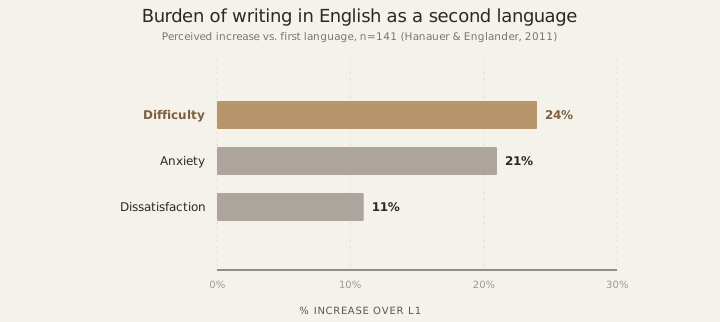
The operational reading is direct: the burden of writing in English as an L2 is real and measurable across more than one dimension, and it is not reducible to vocabulary. And, as Moreno and colleagues (2012)3 show, it concentrates in the discussion, the section of heaviest rhetorical load, and not where the load is merely terminological. That moves the problem away from the word and toward the architecture of the argument, and it explains why a text without a single grammatical error can still return with the verdict that its English needs work.
The rule that Q1 reviewers check is not whether the English is correct, but whether the text performs the rhetorical moves of the target language. The introduction must establish a gap explicitly, not simply present the topic. The discussion must promote the contribution of the work and position it against the literature, rather than restate results. The appraisal of prior work must be direct where the English genre expects direction. None of these moves is a matter of vocabulary.
Hence the distinction that defines the kind of correction required. When the fault is lexical, an imprecise term, an odd collocation, word-by-word revision resolves it. When the fault is rhetorical, the gap that was never delimited, the discussion that does not promote, the critique that does not criticize, only reconstruction resolves it, because the structure has to be rebuilt in the target register. Most rejections attributed to “poor English” belong to the second category, and that is exactly the one that survives a surface edit. Rewriting the sentence while preserving the Portuguese architecture only produces a grammatically English Portuguese.
The choice between the two competing explanations does not change the action. If the problem comes from the transfer of Portuguese patterns, the fix is to rebuild in the English pattern. If it comes from a general bias against disfluency, the fix is the same: produce prose that the target reader processes as native. Under both readings the work falls on the structure, not the lexicon, which is why treating academic translation as word substitution diagnoses the problem at the wrong layer.
A manuscript that reads as natively argued in the target language removes the most common avoidable rejection trigger for non-native authors. The cost of ignoring it is asymmetric: methodologically sound work loses its chance at a review on merit because it reaches the reviewer dressed in the wrong rhetoric. Rhetorical reconstruction does not beautify the text. It returns to the work the possibility of being judged on what it actually found.